
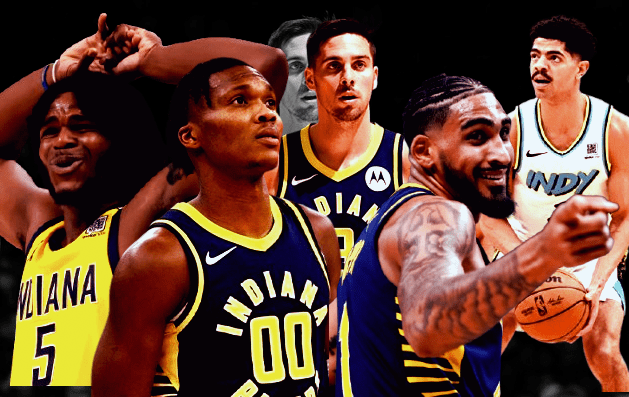
A closer look at the data on lineups featuring the 11 players likeliest to see the court during the Pacers’ 2025 playoff run*
After serving as a reliable fail-safe to end the 2023-24 season and begin this one, the Pacers bench has taken a step backward. The eye test and the numbers tell the same story. Star-led units—those featuring two or more of the Pacers’ three best players (Haliburton, Siakam, and Turner)—have dominated since the NBA Cup. Bench-led units—featuring just one or zero of the Pacers three best players—have lost ground.

After the Pacers March 15 loss to the Bucks, in which TJ McConnell posted a season-worst -35 plus-minus, Tony East of Forbes asked him what he felt was different about the bench units this year: “I feel like the pace, the fight, the spirit was different,” McConnell said, “but we’ll get that fixed.”
Age might be finally catching up to TJ McConnell. He’s getting to the rim slightly less frequently than last year, shooting a lower percentage when he gets there, and a larger share of those at-rim buckets are assisted, rather than unassisted. In other words, he’s struggling to reliably create his own shot to the degree he used to. But the bench’s struggles extend beyond him. Ben Sheppard and Thomas Bryant, two more bench staples, are among the 20 worst open 3-point shooters in the NBA since the all-star break.
The coaching staff will need to keep two of Haliburton, Siakam, and Turner on the court whenever possible. But Rick Carlisle believes in the Pacers’ depth, and they will have to spell their top players periodically to maintain the pace and pressure that define Indiana’s style. That makes it even more important to find a version of the bench that can hold its own.
One potential solution to these struggles lies in the Pacers-Bucks series that began nearly a year ago: playing small. But not just playing small—the Pacers must keep shooting on the floor too.
For the season, bench-led units playing with a traditional center are -4.2 points per 100 possessions; bench units without one are +4.4. In the 156 minutes they’ve played with no center and three or more good three point shooters on the court, the Pacers are outscoring opponents by an even larger 7.2 points per 100 possessions. It’s a stylistic fit, not one based on specific personnel.
Bench units often feature players like McConnell and Benn Mathurin—players wired to punch their way into the paint. No NBA player drove more frequently than McConnell, who attacked the paint a league-leading 23.3 times per 36 minutes. Their ability to force help defenders to choose between staying attached to their man and allowing a drive, or leaving their man open for three is why these small-ball, shooting heavy bench units can work.
Teams often counter this rim attack by going zone and forcing the Pacers to beat them another way. The Bucks are sure to try this strategy, which they’ve used to their success both against the Pacers and the league at large this season. The Pacers’ bench units need to be ready for either scheme: ready to catch and shoot off paint touches against man, or break down the Bucks’ zone with cutting and shooting. Center-less, shooting-heavy lineups give them flexibility to do both.
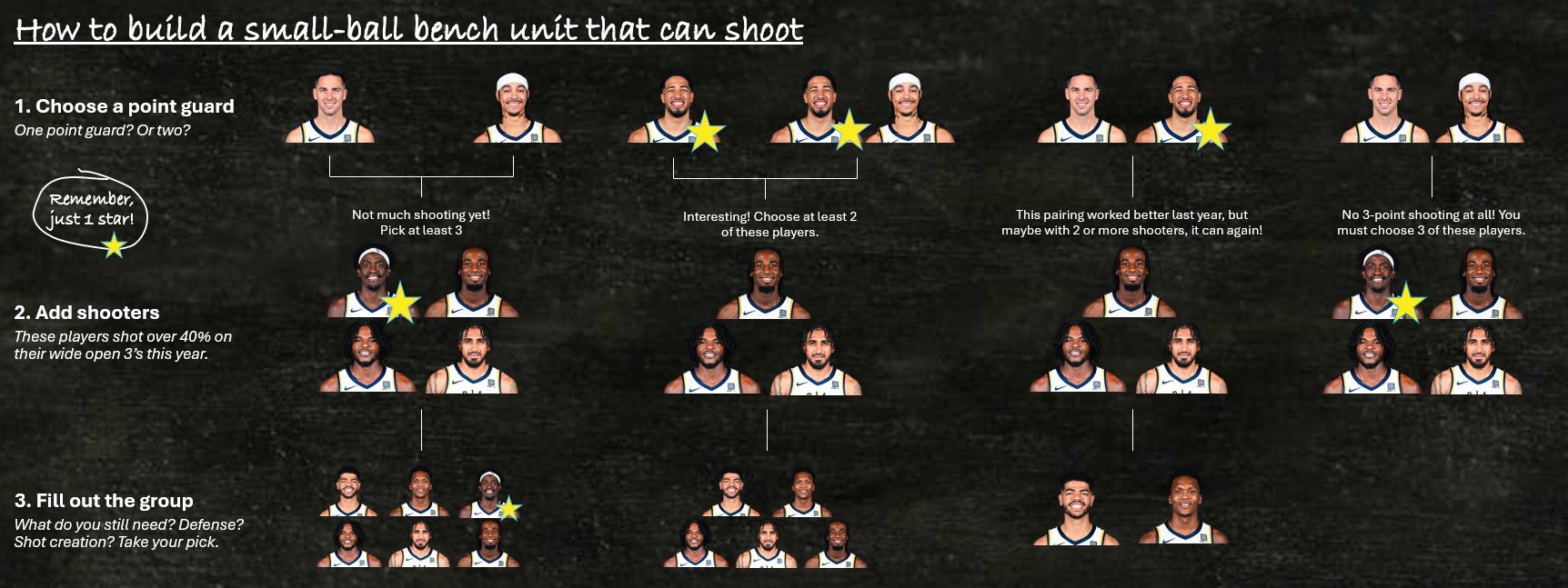
Leaning on lineups like these would represent a departure from how playing time has been divided up this year. The bench is actually playing a larger share of their minutes with a center on the floor now than they did through early February. And shooting hasn’t been common for the bench either: the reserves have played twice as many minutes with two or fewer plus shooters on the court as they have with three or more.
The playoffs are a time for adjustments. The Pacers’ small-ball, shooting-heavy bench lineups have worked in limited stints. Whether as a counter to zone or as a change of pace against Milwaukee’s larger lineups, it’s time for them to be put to the test.
*Throughout this post, only data on lineups including the 11 players leading the team in minutes played are included. Those players are Haliburton, Siakam, Turner, Nembhard, Nesmith, Mathurin, McConnell, Toppin, Sheppard, Bryant, and Walker. Units including some combination of these players are nearly certain to see the overwhelming majority of meaningful minutes in the playoffs. Any lineup including at least one other player outside this top 11 has been excluded. This encompasses roughly 80% of all minutes played. All lineup data come from PBP Stats.
-#31-
 iPacers - Indiana Pacers News