
The Good, the Bad, and the Ugly
Over his final two preseason games, Tyrese Haliburton bombed deep threes in a first quarter game at the Paycom Center and jawed with Milwaukee Bucks players at home. He looked every bit like the player who led the Pacers to the brink of their first NBA title.
How quickly Haliburton can look like himself on a consistent basis is the most important question facing the Pacers franchise. If he can hit his former level quickly, or reach a new, higher level, the Pacers will be title contenders again, perhaps even as soon as this year. If he cannot, the Pacers are almost certain to struggle to avoid the play-in as they compete against a deeper, more competitive Eastern Conference.
Haliburton’s Game 7 Achilles tear will loom over the franchise until they win the title, and for good reason: The Pacers were a half away from the championship, and now Haliburton is facing one of the most daunting injury recoveries an NBA player can face.
Achilles tears are not a death sentence to a player’s career, but, for the handful of players most similar to Haliburton who have suffered the injury, it has usually altered their career for the worse. That does not mean Haliburton can never return to his pre-injury peak, but it does mean he is trying to climb atop a mountain almost no one has successfully scaled.
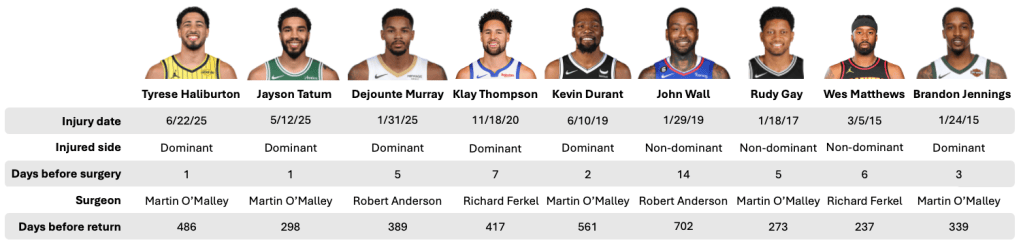
There have been very few players in a similar position to Haliburton: a guard or wing-sized starter or star tearing their Achilles tendon before age 30. In the last decade or so—a period in which surgical procedures and recovery protocols are most likely to be similar to today—only eight other players besides Haliburton meet all of these criteria: Kevin Durant, Klay Thompson, Rudy Gay, Wes Matthews, Brandon Jennings, John Wall, Dejounte Murray, and Jayson Tatum.
Other players who tore their Achilles in this time were either too old (like Damian Lillard) or too dissimilar in position and role (like Isaiah Jackson) to provide reasonable parallels to Haliburton.
Only one of the six players who have played three-plus years post-surgery (Durant) has had a productive post-surgery career. Two, Gay and Matthews, experienced modest declines. Thompson, coming off both an Achilles rupture and ACL tear, has had steady and significant decline. Jennings and Wall had their careers completely derailed and were out of the league in year four post-surgery. For Murray and Tatum, it is too soon to say.
Most of this group had a “dominant” side tear, like Haliburton, meaning they tore the Achilles on the same side as their dominant shooting hand—generally better for recovery outcomes—but others did not. Recovery time and surgeon appear almost completely unrelated to how these players’ careers changed. It is possible an earlier surgery (within 48 hours) is better than a much later one, and surgeons themselves suggest getting surgery faster bodes better for recovery. But on this data point especially, there are too few comparisons to be sure what to expect.
While it would be imprudent to draw major conclusions from these eight other players, in a few key areas, there is a consistent story. Part of it bodes well for Haliburton; part of it does not.
The Good: Efficiency
There is no reason to believe Tyrese Haliburton’s best attributes will decline because of his injury.
Shooting percentages, passing, and scoring per possession are among the attributes which changed the least for the eight comparable players. And for five of the eight players, rebounds per possession increased in their first season back from injury. In fact, on average, rebounds per possession increased by more than 10% in players’ first season back compared to the season in which they tore their Achilles.
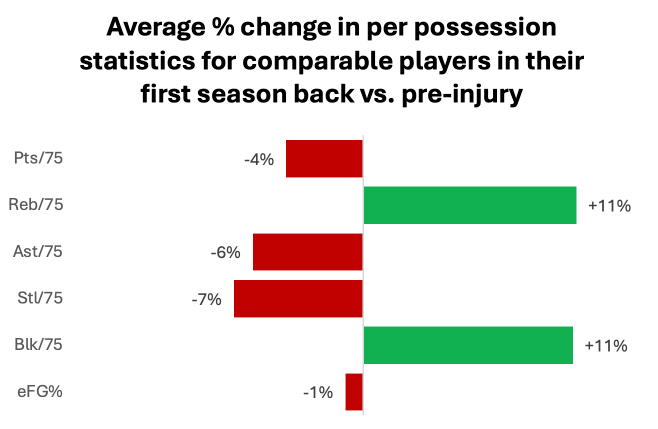
Haliburton’s ability to process the game faster than his opponents is what makes him special. If anything, his time observing the team’s play last year could reasonably be expected to improve his processing, once he gets re-accustomed to NBA game speed. Any improvement or decline among these greatest strengths should be assumed due to other factors, not his injury.
This is by far the best reason to believe that Haliburton’s recovery will be different than others’ recoveries were. He does not rely on explosive athleticism to repeatedly get to the rim like Jennings or Wall or shut down opponents defensively like Thompson used to. His three-point shooting does not rely on sprinting across the court and around screens to create separation. He wins with his eyes and his intelligence. Most of the things that made him an elite basketball player should not be affected by this injury.
The Bad: Availability
For most of the eight comparable players, coming back from an Achilles tear either meant fewer games played, fewer minutes per game, or both.
Before Kevin Durant tore his Achilles tendon, he was not particularly injury-prone, averaging 71 regular season games played per year. In his first three years back after the tear, his injury problems mounted: he played only 45 games per year during that time, even as he played the same, or even higher, minutes per game compared to pre-injury when he was on the court.
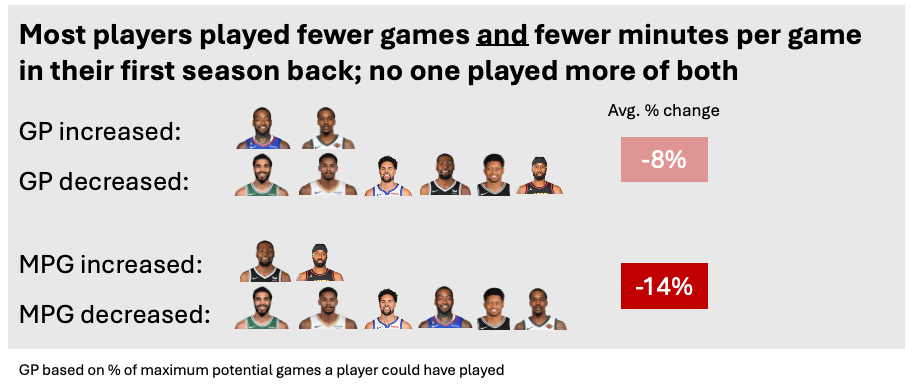
Thompson, Jennings, Gay, and Wall all saw their minutes per game decline dramatically post-injury, never recovering to their pre-injury level.
Neither Dejounte Murray nor Jayson Tatum played in any back-to-back games after they returned to play last season. When Murray and Tatum did play, they played fewer minutes than any season in the last five years. Tatum even missed game 7 of the Celtics’ first-round series against Philadelphia. The reason? He was “still in the window of return-to-play protocol.”
No comparable player played both more minutes per game and more games per year than they did pre-tear.
Haliburton has been emphatic that he faces few, if any, restrictions, but history suggests there will be bumps on the road.
Declining minutes and fewer games mean less impact. For example, across the eight comparable players, scoring per possession declined on average by just 4% in players’ first seasons back—essentially no change at all. But if you look at per game statistics, then scoring declined by 17% on average. In fact, all major box score categories declined on average across the eight players in year one on a per-game basis. That discrepancy between per possession and per game statistics is because when players return, they usually play fewer minutes than they used to, especially in their first season back.
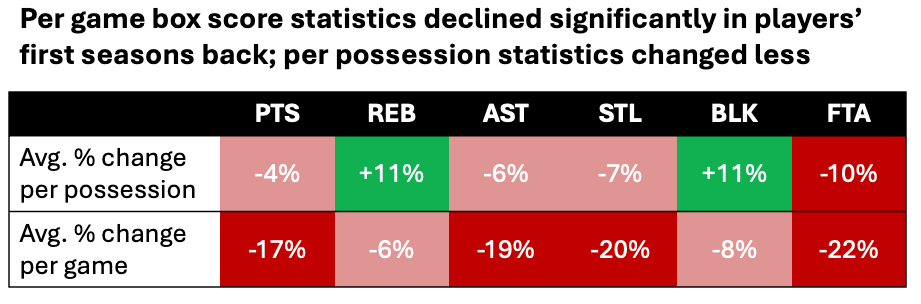
If Tyrese Haliburton is playing fewer games, fewer minutes, or both this season, it bodes poorly for a team that has struggled mightily in his absence.
The Ugly: Explosiveness
None of the players most comparable to Haliburton have seen their explosiveness ever return to its pre-injury level. Across the handful of statistics most closely related to explosive athleticism, the story is consistent and concerning.
Dunks, Dives, and Rim-Finishing Drives
No post-surgery statistic is as consistent as dunks: They decline substantially for everyone, regardless of any factors related to time off or injured leg. Prior to tearing his Achilles in 2015, Wes Matthews dunked the ball 10 times in 60 games played. Matthews continued to play in the NBA nine more years after his injury. In that time, he only dunked the ball 5 more times, total.
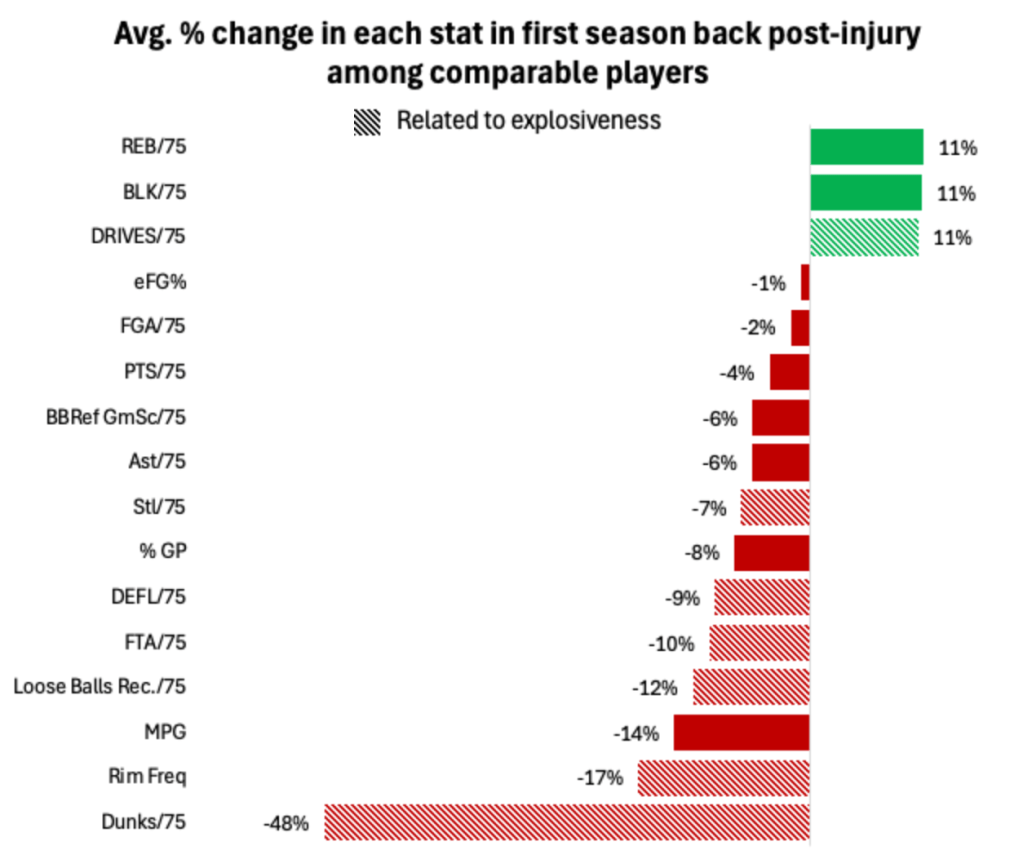
There are no exceptions among the eight comparable players. Even three years post-surgery, all recent comparable players were dunking half as often as they were before, or less. Durant dunked 1.54 times per 100 possessions prior to rupturing his Achilles; three years later, he was down to 0.74 dunks per 100 possessions, a 52% decline. Tatum dunked 1.1 times per 100 possessions before his tear; last year when he returned, that declined to 0.41 times per 100 possessions, a 63% decline.
Free throws attempted and rim frequency follow a similar pattern. For most of the eight players, they declined a lot. Encouragingly, Tatum and Murray were among the most resilient by these measures, with Murray in particular taking a much higher share of his shots at the rim last year than he did prior to injury, but he stands apart from the overall trend.
Other plays requiring acceleration and explosiveness have typically also declined.
In the last 10 years, the NBA has begun tracking a stat called “loose balls recovered.” It counts the number of times a player recovers a ball when neither team had possession, such as diving on the floor or chasing down deflections.
Diving after a ball requires explosiveness; many steals and deflections require sharp acceleration or even jumping into a passing lane. These are the kinds of movements it seems players may not be able to do to their pre-injury level after they return. In year one, on average, players declined 10% on these measures; by year two, 25%; and by year three, 30% compared to their pre-injury level. Not all players declined in year one, however. Dejounte Murray’s steals, deflections, and/or loose balls recovered actually increased on a per-possession basis after he returned from injury.
For someone like Haliburton, who has generally racked up quite a few deflections, steals, and loose balls recovered for the Pacers, this could be the equivalent of missing out on 1-2 possessions per game if other players don’t pick up the slack.
It is impossible to know whether explosive plays are less frequent because players can’t physically produce the necessary force, because of mental barriers a player may have when it comes to making explosive plays, or a combination of the two. Jayson Tatum has said he believes it is primarily mental, telling Dan Patrick earlier this offseason that when he returned from injury last year, he was nervous before every game he played.
The Ugly, continued: A short summary of medical research on return from Achilles ruptures
A cursory review of medical research on Achilles ruptures is bleak. Nearly all medical research finds NBA players’ performances significantly decline after injury. For example, research has found NBA players who suffer Achilles ruptures, on average, play fewer games, play fewer minutes, and have worse box score performances compared to their earlier career selves and comparable uninjured players in the first two seasons after they return. Multiple studies have found significant declines in advanced statistic metrics for injured players in the years after their return to play. Research finds that most all-star level players never return to their pre-injury form.
There is some scientific evidence that NBA players can eventually return to pre-injury levels of production, though often two to three seasons after the injury, not right away.
Dr. Martin O’Malley, who performed Haliburton’s surgery, as well as many others, has echoed this timeline himself: “At two years,” he said, when speaking about Kevin Durant’s recovery in 2021, “They should expect a full recovery.”
Expecting an earlier return to peak form than that is not consistent with the medical literature. There is no medical research I am aware of suggesting that NBA players are likely to immediately return to pre-injury form.
What are fair expectations for Tyrese Haliburton?
Patience. To begin the year, I expect Haliburton to show flashes of his former self, but it might not be until Christmas or the All-Star Break that he begins to look like himself on a regular basis. And it may not even be until the 2027-28 season or later that he reaches whatever his new peak level is post-injury.
Haliburton has been streaky in the past, starting the 2023-24 season so well he led all East guards in all-star fan voting at one point and then starting the following season so poorly he considered taking time away from the team to regroup. The early portion of the season may be more like a roller coaster than either of his past two, but I expect it to trend in a positive direction overall.
I am most concerned about the possibility of Haliburton playing fewer minutes and missing more games. When he is on the court, I am most concerned that declining rim frequency combined with more predictable step-back threes (I suspect he may skew even more toward stepping back off his un-injured leg) will make him a somewhat predictable scorer and, therefore, easier to defend. The Pacers’ free throw gap vs. their opponents could become an even bigger issue than it has been in the past.
A slow or inconsistent start to the season would fit the pattern of comparable players who have returned from Achilles tears in the last ten years. An All-NBA level start is possible, and certainly Tyrese himself seems to believe it, but it would be a surprise based on what his peers have experienced.
Hopefully, Tyrese follows the timeline his doctor has ordered, with a return to peak form in late spring 2027—right in time for the playoffs to begin.
—
ENDNOTE: All analysis conducted by the author. Stats were primarily sourced from Basketball Reference and NBA Stats. Possession data is from PBP Stats. All stats include data from playoffs. Year one comparisons are based on the entire season a player returned from injury compared with their performance in the year leading up to their injury.
-#31-

