
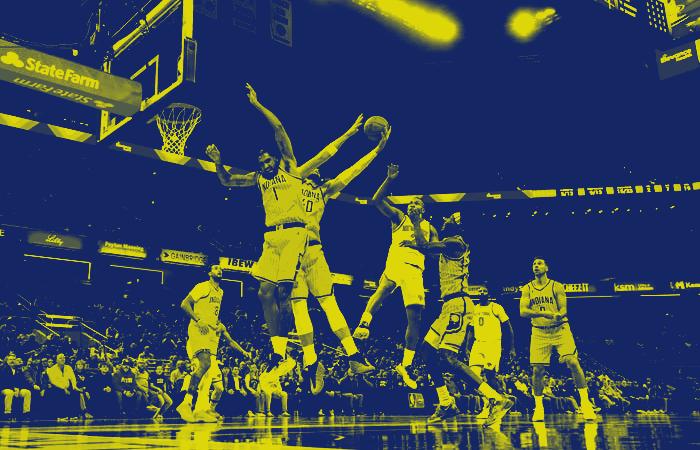
NotW: 30th, as in dead last. After two seasons near the bottom of the league in offensive rebounding, Indiana has gotten worse–in part because the league has changed around them
The only reason Quenton Jackson recorded the Pacers’ lone offensive rebound against the Dallas Mavericks was because it was an airball, and nobody on the Mavericks was standing directly beneath the basket when it fell feet short of the rim. Jackson promptly threw it out of bounds.
That rebound, which occurred with 3:33 left in the fourth quarter, is the only reason the Pacers avoided a goose egg on the offensive glass.
It is very difficult for a team to record zero or one offensive rebounds in an NBA game. But two of the last eight times it has happened–a period which covers more than three calendar years–Indiana did it.
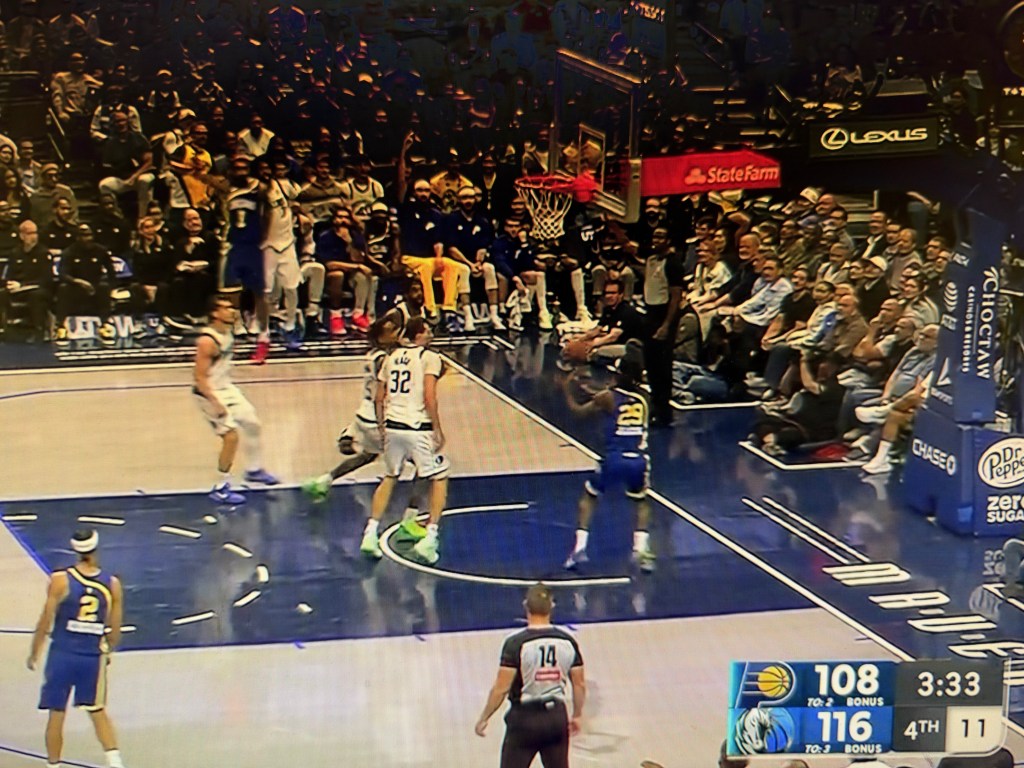
Indiana’s only offensive rebound in their Nov. 9 loss at Dallas
After dropping the game against Dallas a week ago, the Pacers were rebounding only 22.5% of their misses, last in the league by far. To be precise, they were 7.6 percentage points worse than league average at the time, which was the widest gap between any team and league average since Cleaning the Glass began tracking this data in 2003.
The Pacers turned things around mid-week, recording double-digit offensive rebounding performances in their wins against Washington and New York. In both games, the Pacers performed above league average on the offensive glass, pulling down more than 30% of their misses.
The first half against Philadelphia continued the positive trend, but by the second half, Ivica Zubac had played his way on to the bench, and the Pacers grabbed only two more of their misses the rest of the way (both by Jalen Slawson).
With Zubac on the floor this season, the Pacers have rebounded the ball well enough on both ends. Their offensive rebounding rate when he plays has been around 29%; defensive rebounding, around 75%. Both are decent enough figures for a center. When Huff is on the floor, however, those figures fall to 20% and 68%, respectively, per PBP stats. Both marks are among the worst for any big man in the league.
Failing to follow your shot, on its own, is not necessarily harmful, particularly if you effectively limit transition opportunities for your opponents, which Indiana does. But failing to get your own misses while also failing to corral your opponent’s misses can be fatal. Through the first 14 games of the year, the gap between Indiana’s offensive rebounding and their opponent’s has been 5.4% on average–worse than either of their two previous seasons, but fairly typical for a 14-game stretch during that time.
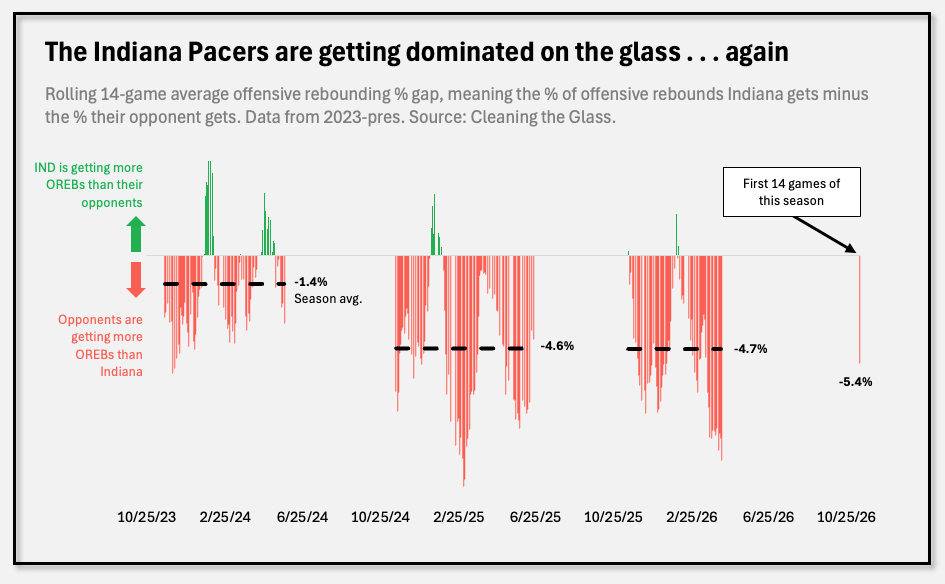
As bad as this season has been on the boards, this is about as “bad” as normal for this number of games for Indiana. Instead, what has changed is the rest of the league: The Pacers’ offensive rebounding is stuck on cruise control while the league has accelerated around them. And Indiana has changed too, dropping from a dominant ball security team to a merely good one.
These trade-offs in the possession battle put more pressure on Indiana’s offense to make shots. Unfortunately, they haven’t been doing much of that lately either: their loss against Philadelphia was already their fourth time this season shooting 25% or less from 3.
Average shooting and good-but-not-great ball security have been hallmarks of the Haliburton-less Pacers. If these persist in his absence, as they are likely to, then the Pacers may need to consider finding a new way to get an edge. One option is to follow the trend of the league and become merely bad on the glass, instead of what they are now, which is terrible.
-#31-

